I've been familiar with Weight Watchers nearly all my life.
My father was an early devotee and we sampled lite cuisine for many a meal. I credit the Weight Watchers cookbook with teaching me to love fish. As awful as it sounds now, my Mom used to prepare a buttermilk sauce for Sole that was out of this world.
As a teen and young adult, I had no need for Weight Watchers or any other diet plan. I ate what I wanted and burned the calories off with Ponce de Leon-like ease.
Soon after my wedding, however, I noticed that somehow, my sides were bulging in odd ways. It was as if breast implants had failed and slid down and to the sides.
"Love handles," were what they were affectionately called. (Affectionately is a euphemism for "said by family members who can get away with saying anything.").
In 24 years of marriage, I've been weight watching in the traditional sense. That is to say, watching my weight go up and up and up. 180 and athletic became 220 and pathetic.
So I'm on the wagon now. Watching the points and trying to get active. Muscle mass is "use it or lose it;" so I'm working out a few more minutes each day.
Truth is, after so many years of resisting this type of reform, I'm enjoying it. Meals and work outs are spent conferring with my wife and this only adds to the things that we enjoy together.
I'm feeling better and now that I have to track my points and read labels, I'm somewhat abashed at the amount of calories and fat that I used to consume at one sitting.
Today was my third Weight Watchers weekly gathering and as I heard people tell the stories about how the choices they made affected their physical well being; how exercise and diet helped diabetes and other chronic ailments, it occurred to me that the whole national health care debate is missing an important component - lifestyle choices.
This is not to say that the topic has been totally forgotten. Anti-smoking forces have been saying for years that increased cigarette taxes were only fair since the non-smoking population shouldn't be required to pay for the increased burden on the health care system caused by the personal choices of the smokers.
How then, is that any different than the increased burden placed on the health care system by the lifestyle choices of overeaters or couch potatoes? How about drug users or fast drivers?
When is it appropriate for the citizenry to put constraints on the lifestyle choices others make as a prerequisite for the health care that they are willing to pay for?
In anticipation of that debate, I'm going to have a 1-point fudgsicle.
Thursday, May 24, 2007


Tuesday, May 01, 2007

Tuesday, February 13, 2007
Wanderlust Part I

Personal - The Indians I met brought new meaning to the word hospitality. Before this trip I thought the Arabs were the most gracious hosts; but the Indians were as generous and thoughtful as the Lebanese, Palestinians and Jordanians I know -- and then some. Not an hour went by that someone wasn't wondering if I was: comfortable, hungry, tired, bored, thirsty, lonesome, overwhelmed, etcetera. At the end of every day we would start to plan out the next day and they would ask me when I wanted to start our meetings. When I would say "whenever it's convenient for you," they looked at me as if I was speaking Swahili. They didn't have any ego or pretense in their corporate hierarchies. When we went to visit fab shops or engineering firms, CEOs took time out of their day to lead the tours. No task was too menial, no kindness was overlooked. If you are looking to go somewhere with a "personal touch," I recommend this area of
Cultural - I only took one day to tour and was able to visit the palace at
Economy - Demographers predict that
One day we needed to go shopping for some timing belts and bearing assemblies. The streets were lined with book vendors who had hundreds of titles stacked 6 feet in the air. A few were novels, some more were business non-fiction; but 80% were science, software and engineering titles like "Fluid Dynamics," "Mechanical Devices," "Programming in Perl," etcetera. Chemistry, Physics, Software, Electronics were all subjects about which you can buy scores of texts from a
One company we visited had 10 advanced CNC machine tools making parts for Canadian and US customers. In my conversation with the CEO of the company he told me that he had started his business in a small shed (garage) 6 years ago and now has 180 employees in three facilities. (The funny part of that conversation was that he was showing me a part coming off the line and told me that it was made for a company that he was visiting next month in WV. Turns out the company is right up the road from my farm.)
Political - I didn't get to spend too much time on politics while I was there except to note that one day we were warned not to go to a certain area of town because of a riot happening there. There was a march of Muslim "students" protesting the killing of Sadaam Hussein. This protest turned into a riot with shops sacked and cars burned.
There are not many countries that I feel compelled to return to immediately, but India is definitely such a place.
Wednesday, December 27, 2006
Thanksgiving
As the year comes to a close, I saw a couple of quotes on gratitude that I thought were eloquent and worthy of repetition:
"Gratitude is the most exquisite form of courtesy." - Jacques Maritain
"My country gave me schooling, independence of action and opportunity for service. I am indebted to my country beyond any human power to repay." - Herbert Hoover
I was taught that the power of a thank you is in the description of that for which one is grateful and the reasons why.
Children are wont to throw a quick "thank you" or an even quicker "thanks" as they grab a gift or treat and run off to enjoy it. Far fewer are the times when we hear someone express their gratitude properly and fully.
I've told my children that a proper thank you is like a book report - it has to express to the listener the Who, What, When, Where, Why and How of the thanks.
Grandson opens the birthday card and sees the iTunes gift certificate for $15 and says:
Scenario 1: "Oh great! iTunes!!! Thanks Grandad."
Scenario 2: "Thank you Granddad for the iTunes gift card. I use my iPod all the time and I haven't had enough money to get the new Rascal Flatts songs that I like. Now I'll be able to buy those and some other new songs to listen to while I'm riding the bus to school. I was hoping to get one of these."
I'll admit that it's hard to remember to thank someone properly and even more difficult to get one's children to do so as well. But after a while it can become second nature.
Anyway, thanks for reading this blog...........
"Gratitude is the most exquisite form of courtesy." - Jacques Maritain
"My country gave me schooling, independence of action and opportunity for service. I am indebted to my country beyond any human power to repay." - Herbert Hoover
I was taught that the power of a thank you is in the description of that for which one is grateful and the reasons why.
Children are wont to throw a quick "thank you" or an even quicker "thanks" as they grab a gift or treat and run off to enjoy it. Far fewer are the times when we hear someone express their gratitude properly and fully.
I've told my children that a proper thank you is like a book report - it has to express to the listener the Who, What, When, Where, Why and How of the thanks.
Grandson opens the birthday card and sees the iTunes gift certificate for $15 and says:
Scenario 1: "Oh great! iTunes!!! Thanks Grandad."
Scenario 2: "Thank you Granddad for the iTunes gift card. I use my iPod all the time and I haven't had enough money to get the new Rascal Flatts songs that I like. Now I'll be able to buy those and some other new songs to listen to while I'm riding the bus to school. I was hoping to get one of these."
I'll admit that it's hard to remember to thank someone properly and even more difficult to get one's children to do so as well. But after a while it can become second nature.
Anyway, thanks for reading this blog...........
powered by performancing firefox
Monday, September 11, 2006
Size Does Matter

I spent last weekend camping out with my son's Boy Scout Troop aboard the USS New Jersey. This masterpiece of naval architecture is the , fastest, strongest, longest and most decorated battleship in the world. She was born during WWII and was taken out of and put back into service a record 5 times. After serving off of Beirut in the 80's she was finally mothballed and then retired in Camden, NJ where she now patiently entertains thousands of fans and former colleaugues.
We learned how the big 16" 50 caliber guns (6 forward and 3 aft) accurately placed rounds the weight of a VW bug on target 26 miles away. We saw the batteries of dual 5" guns that only throw projectiles 10 miles away or 36,000 feet skyward (anti-aircraft), the Phalanx anti-missile / anti-aircraft systems and the quad batteries of Tomohawk Cruise Missiles.
Unfortunately, we weren't on board long enough to properly tend to the 6 on board museums, but I am sure we'll allocate time when we return; and we certainly will return.
The Battleship New Jersey accepts families, scout groups and other organizations for overnight encampments. They provide dinner, breakfast, a guilded tour and time in a flight simulator. Th docents were knowledgeable and pleasant and bunking in the Navy racks gave the kids something that they won't experience at Disneyland. I highly recommend it.
http://battleshipnewjersey.org 1-866-877-6262 extension 203

Tuesday, September 05, 2006
Lucky Dog

I'm a lucky dog. Came out of that one clean.
No need to worry, I'm fully recovered now.
Please don't make a fuss. The surgery was a complete success.
Yes, it was a serious infection.
Yes, many people have died from it.
Yes, it could have been fatal.
But I'm fine. Really!
What did I have?
A Periapical infection and a root canal.
You see it is only by virtue of the fact that I was born in the US in 1958 that I'm alive. Had I been born 150 years ago or 150 miles south of the the border, it's quite possible that the infection would have gone untreated and I would quite possible have died.
Althouth the pain of the infection was excruciating (the root canal was a piece of cake by comparison), I never feared for my life. I knew that once I made the decision, I would have my pick of hundreds of trained medical practitioners who would operate on me and within a couple of days I would be back to normal.
How different the fate for so many people in so many far away places and times.
As I was recuperating I began to list the number of times that I was saved by the fortune of my birth place and time.
Well there's the fact that I was a 3.5 pound baby born 6 weeks premature. That's almost certainly curtains for most of the history and geography of the world.
Then there's the childhood bleeding disease that the doctors at first thought was hemophelia but later successfully treated with cortizone therapy.
Then there's the time I had infected tonsils and the time I fell off the cliff and the time in college when I had meningitis. Oh yeah and don't forget last year's dance with thyroid cancer.
Let's see, that's six times in my life where in other times and places I most certainly would have been that many feet under.
Perhaps I'm not a lucky dog. Perhaps I'm of the feline persuasion and I've got three more lives left to burn.
Sunday, September 03, 2006
Gone But Not Forgotten
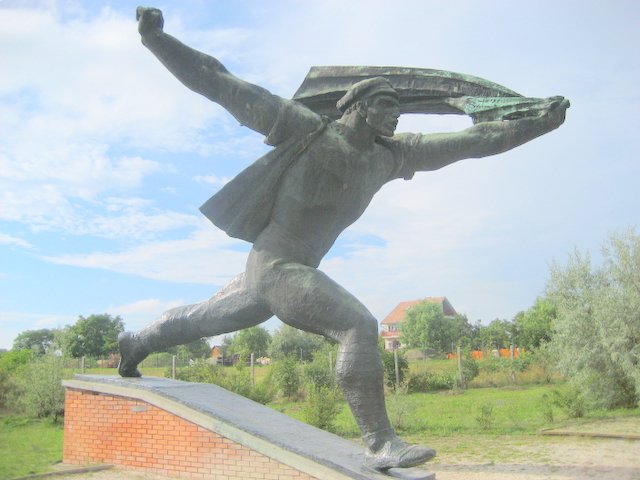 On a recent trip to Budapest, our family stopped at the Communist Statue Park (graveyard). My children were raised on a steady diet of anti-communism, so it was interesting for them at an intellectual level.
But standing before these icons of an oppressive era thankfully gone by, I was struck by a tremendous sense of what I could only identify as nostalgia mixed with de ja vu.
Nostalgia:
Growing up in the 60's we learned to duck under our desks during the mock air raid drills. We cheered on the Mercury, Gemini and Apollo spacemen as they sought to best the Cosmonauts. We heard the body counts on the radio as young men came back from Vietnam in bags in the fight against Communist North Vietnam. We saw Communism spread across the globe from Peru to Nicaragua in our hemisphere to places like Ethiopia and Burma half a world away.
De Ja Vu:
I remember that there was a sense of invincibility about Communism in general and about the Soviet Union in particular. Nobody really thought you could beat the Soviet Union - they were too big, too committed AND they were everywhere. The Communists were pressing us everywhere. The only continent that seemed safe was Antarctica. The best we could hope to do is to appease and contain them.
Amazingly enough, we hear the same things today about Radical Islam.
They're too big.
Too committed.
And besides, they're everywhere. Muslims in Africa. Muslims in Asia. Muslims taking over Europe.
The best we can do is appease and contain them.
One day, my children will take my grandchildren to the new World Trade Center. They'll tell them how when they were growing up nobody thought that we'd be able to defeat Radical Islam. How they bombed us and killed our innocents. How we fought great wars to free enslaved peoples in their countries.
I'm sure at an intellectual level, my grandchildren will be interested.
But the sight won't stir their souls like it will for my children.
Just like it did for me when I saw this statue.
Saturday, September 02, 2006
They Never Get It
A few weeks ago a terrorist was arrested in Germany. The police and intelligence agencies there found out that he was planning to blow up two commuter trains. I had just returned from Germany and read the reaction in the press. Everyone was shocked and amazed.
The terrorists are targeting Germany! But we're not the bad guys like America! We're good like France!
USA Today reported:
The truth is that no matter what Germany or any of the other EU countries do, terrorism is now an unfortunate fact of life. Neutrality is not an option. Only vigilance and activism will serve to safeguard the West.
In 1972 Germany became the bed where the seeds of terrorism were planted. The German people thought that it was Israel's problem and have by and large sat idly by as the US, the UK and Israel have faced Radical Islam. Now these seeds have grown into weeds that are threatening to choke Germany. After 34 years, they still don't get it.
The terrorists are targeting Germany! But we're not the bad guys like America! We're good like France!
USA Today reported:
"Germany's refusal to take part in the U.S.-led war in Iraq once had Germans thinking Islamic terrorists would focus elsewhere, said Lesch's wife, Marita, 52, a teacher. "We didn't fight in Iraq, and until now we assumed that if we behaved well in the world, nothing would happen to us," she said.
Michael Lüders, a Middle East expert and government policy consultant, said, "Germany is reorienting its (foreign) policy. It did not call for an immediate cease-fire (during Israeli attacks) in Lebanon, and that was disappointing in the Arab world. Some radical forces now think Germany should be punished," he said."
This is an incredible rationalization of terrorism. In short, if Germany or the West doesn't toe the radical Muslim line, it will become a target. Neutrality is now not enough, activism on behalf of radical Muslism is the only way to avoid being an enemy.The truth is that no matter what Germany or any of the other EU countries do, terrorism is now an unfortunate fact of life. Neutrality is not an option. Only vigilance and activism will serve to safeguard the West.
In 1972 Germany became the bed where the seeds of terrorism were planted. The German people thought that it was Israel's problem and have by and large sat idly by as the US, the UK and Israel have faced Radical Islam. Now these seeds have grown into weeds that are threatening to choke Germany. After 34 years, they still don't get it.
Tuesday, August 29, 2006
Central Synagogue Budapest

My sister Linda and I attended Sabbath services here at the Central Synagogue in Budapest. The grandeur of the architecture and the resplendent renovation only served as stark contrast to the declining Jewish population and scarce attendance. The Orthodox synagogue down the street, while a fraction of the size, had three times the attendance. In pre-war Hungary Jews made up 25% of the city's population. After the devastation of the Holocaust and subsequent emigration the community is barely a shadow of the vibrant community that lived here.
Thursday, May 11, 2006
I don't have a dog in that fight
I'm in Amsterdam at a trade fair this week and have had the opportunity to walk around the town a bit. Today's trek took me through some of the many parks and green spaces that dot the cityscape.
I was impressed by the number and quality of the parks. I was impressed by the scores of people - both young and old, singles, couple and groups, eating, reading, walking and riding.
But what struck me most of all were the dogs.
Dogs of every kind, size, breed, sex and age.
Dogs laying at their owner's feet.
Dogs fetching thrown objects.
Dogs playing tug-of-war with each other for a stick.
Dogs wading and swimming.
Dogs pacing their running, trotting, walking and riding owners.
But not one of the dogs had a collar or a leash. Not one!
Perhaps this is in keeping with the ethos of a city that tolerates legal public drinking, marijuana smoking and prostitution.
Perhaps it was a coincidence.
Perhaps it was a sign of the coming of the Messiah.
My theory, however, is that in the absence of strict leash laws (like those that litter the law books of American towns and cities) dogs and owners learn to behave properly.
I think that the freedom to misbehave actually creates a more disciplined environment. Dogs and dog owners self-policed and created a situation that justifies the absence of leash laws.
Would it only be so in our society. If people would self regulate, governments would not feel compelled to legislate our every thought, word and deed.
With freedom comes responsibility.
With responsbility comes freedom.
I was impressed by the number and quality of the parks. I was impressed by the scores of people - both young and old, singles, couple and groups, eating, reading, walking and riding.
But what struck me most of all were the dogs.
Dogs of every kind, size, breed, sex and age.
Dogs laying at their owner's feet.
Dogs fetching thrown objects.
Dogs playing tug-of-war with each other for a stick.
Dogs wading and swimming.
Dogs pacing their running, trotting, walking and riding owners.
But not one of the dogs had a collar or a leash. Not one!
Perhaps this is in keeping with the ethos of a city that tolerates legal public drinking, marijuana smoking and prostitution.
Perhaps it was a coincidence.
Perhaps it was a sign of the coming of the Messiah.
My theory, however, is that in the absence of strict leash laws (like those that litter the law books of American towns and cities) dogs and owners learn to behave properly.
I think that the freedom to misbehave actually creates a more disciplined environment. Dogs and dog owners self-policed and created a situation that justifies the absence of leash laws.
Would it only be so in our society. If people would self regulate, governments would not feel compelled to legislate our every thought, word and deed.
With freedom comes responsibility.
With responsbility comes freedom.
Tuesday, April 25, 2006
God's Hot Dogs
A friend of mine and I were commiserating on the viscissitudes of business. I told him that I thought that his idea was brilliant and he said:
"If I'm so smart, why am I so broke?"
I've heard that in one form or another from others. Indeed, I've thought it myself on occasion.
The only answer that makes sense, is that smart and rich aren't necessarily connected. There are plenty of rich dummies and poor geniuses.
To take it a step farther, there are plenty of smart, good looking, poor people; and some good looking, poor ignoramuses. And the permutations get really interesting when you add in athleticism.
The only thing I can figure is that we're all God's little hot dogs. Money, good looks, intelligence, athleticism and other attributes that we desire are God's condiments.
Mustard doesn't cause ketchup, they only make periodic appearances together.
Just once I'd like to be a chili dog with the works.
"If I'm so smart, why am I so broke?"
I've heard that in one form or another from others. Indeed, I've thought it myself on occasion.
The only answer that makes sense, is that smart and rich aren't necessarily connected. There are plenty of rich dummies and poor geniuses.
To take it a step farther, there are plenty of smart, good looking, poor people; and some good looking, poor ignoramuses. And the permutations get really interesting when you add in athleticism.
The only thing I can figure is that we're all God's little hot dogs. Money, good looks, intelligence, athleticism and other attributes that we desire are God's condiments.
Mustard doesn't cause ketchup, they only make periodic appearances together.
Just once I'd like to be a chili dog with the works.
Saturday, March 18, 2006
Stupid Reporter
Molly Moore of the Washington Post has got to go back to school and learn some French. She obviously translated the comments of some poor frail French students incorrectly in yesterday's paper.
Just to give you some background on the article, and estimated 250,000 French students were protesting across France in response to a proposed change in the labor laws that would allow employers to fire, at will, any employee under 26 years old within the first 24 months of employment.
Here is what she quotes the students as having said about why they were protesting:
"They are offering us nothing but slavery."
"You'll get a job knowing that you've got to do every single thing they ask you to do because otherwise you may get sacked."
"I'd rather spend more time looking for a job and get a real one."
Certainly Moore got this all wrong. This has to be a mis-translation.
Even knowing the French, it's hard to believe that hundreds of thousands of French students are rioting because they might have to actually work at a job!
Sacre Bleu! Not work! This is "noting but slavery."
The real translation must be something like this:
"They're offering us nothing but unemployment. Liberalize the rules further so that companies can actually create some jobs here"
"I wouldn't mind doing everything my employer asks since they are actually paying me."
"I'd rather spend my time working at a job rather than protesting so that there's a chance that some of the jobs might stay here instead of going to Hungary and Romania."
I'm sure that's what happened.
It must have been a translation error.
Really.
Just to give you some background on the article, and estimated 250,000 French students were protesting across France in response to a proposed change in the labor laws that would allow employers to fire, at will, any employee under 26 years old within the first 24 months of employment.
Here is what she quotes the students as having said about why they were protesting:
"They are offering us nothing but slavery."
"You'll get a job knowing that you've got to do every single thing they ask you to do because otherwise you may get sacked."
"I'd rather spend more time looking for a job and get a real one."
Certainly Moore got this all wrong. This has to be a mis-translation.
Even knowing the French, it's hard to believe that hundreds of thousands of French students are rioting because they might have to actually work at a job!
Sacre Bleu! Not work! This is "noting but slavery."
The real translation must be something like this:
"They're offering us nothing but unemployment. Liberalize the rules further so that companies can actually create some jobs here"
"I wouldn't mind doing everything my employer asks since they are actually paying me."
"I'd rather spend my time working at a job rather than protesting so that there's a chance that some of the jobs might stay here instead of going to Hungary and Romania."
I'm sure that's what happened.
It must have been a translation error.
Really.
Friday, March 17, 2006
You Movin Too Fast
A child psychologist once told me that children are often psychologically impacted by frequent moves and changes of lifestyle.
Military families have long known the trauma of uprooting their children every two to three years as their postings change and many families have evolved elaborate rituals around the move to lessen the strain.
I lived in the same house from birth until I moved away for college. Even then, I attended undergraduate and graduate school less than a mile from my parent's home.
By contrast, my children moved from Springfield, VA to Union, WV to Huntington, WV back to Springfield, and then to Ft. Lauderdale and back between 1992 and 2001. Six moves in eight years.
Our children have complained often that this period of chaos in their lives was severe and irreperable. They suffered from insecurity, from a lack of permanence that comes from never having experienced the comforting monotony of stasis.
Until recently I was not as sympathetic to their plight as I now know I should have been. Spending 22 years living in the same town had given me a strong desire for change. New faces and new places were a welcome change, not something to be feared. I looked (and look) forward to forging new relationships with persons places and things (or "nouns" as my 2nd grade teacher Mrs. Sands used to say).
Lately, however, I've begin to notice a discomfort in society. An insecurity borne of an eerily similar lack of permanence to what my children felt growing up. Nothing stays the same for very long.
You can see this in the macro and in the micro.
Watch any TV show in Fast Forward mode. No scene will stay in sharp focus for more than a few seconds. Do the same for the commercials -- they are a rapid fire montage of images and sound that bombards the soul
At the societal level, we move from fashion to fad to mania to passe in a matter of months. Today's hero is tomorrow villain. We raise up our idols only to smash them down in the public square of humiliation and scorn.
Long term means a year, and permanence means less frequent transitions. We are living the Orwellian double speak in our own lives.
The picture that came to mind the other day was of a phonograph needle on an old vinyl LP. In the opening tracks, the stylus rides gracefully along the perimeter without a mood or care. The longer it plays and the closer it approaches the middle, the shorter the time allowed to complete each revolution.
Round and round we go. The changes becoming ever more frequent and severe.
And even the change changes. Once orderly and predictable, societal change has become a helter skelter experience of staccatto disruptions brought to us in real time by cell phones, internet and wirelessly connected PDA's.
I think living in the big city is getting to me. Maybe I'll move.
Military families have long known the trauma of uprooting their children every two to three years as their postings change and many families have evolved elaborate rituals around the move to lessen the strain.
I lived in the same house from birth until I moved away for college. Even then, I attended undergraduate and graduate school less than a mile from my parent's home.
By contrast, my children moved from Springfield, VA to Union, WV to Huntington, WV back to Springfield, and then to Ft. Lauderdale and back between 1992 and 2001. Six moves in eight years.
Our children have complained often that this period of chaos in their lives was severe and irreperable. They suffered from insecurity, from a lack of permanence that comes from never having experienced the comforting monotony of stasis.
Until recently I was not as sympathetic to their plight as I now know I should have been. Spending 22 years living in the same town had given me a strong desire for change. New faces and new places were a welcome change, not something to be feared. I looked (and look) forward to forging new relationships with persons places and things (or "nouns" as my 2nd grade teacher Mrs. Sands used to say).
Lately, however, I've begin to notice a discomfort in society. An insecurity borne of an eerily similar lack of permanence to what my children felt growing up. Nothing stays the same for very long.
You can see this in the macro and in the micro.
Watch any TV show in Fast Forward mode. No scene will stay in sharp focus for more than a few seconds. Do the same for the commercials -- they are a rapid fire montage of images and sound that bombards the soul
At the societal level, we move from fashion to fad to mania to passe in a matter of months. Today's hero is tomorrow villain. We raise up our idols only to smash them down in the public square of humiliation and scorn.
Long term means a year, and permanence means less frequent transitions. We are living the Orwellian double speak in our own lives.
The picture that came to mind the other day was of a phonograph needle on an old vinyl LP. In the opening tracks, the stylus rides gracefully along the perimeter without a mood or care. The longer it plays and the closer it approaches the middle, the shorter the time allowed to complete each revolution.
Round and round we go. The changes becoming ever more frequent and severe.
And even the change changes. Once orderly and predictable, societal change has become a helter skelter experience of staccatto disruptions brought to us in real time by cell phones, internet and wirelessly connected PDA's.
I think living in the big city is getting to me. Maybe I'll move.
Monday, March 06, 2006
Alchemy
The history of modern science is rooted in the work of the alchemists. Scientist-Philosophers throughout the pre-modern era in all regions of the world sought to change the base into the precious. The plentiful into the rare. The common into the sublime.
In pursuit of this goal, science proceeded from microscopic to molecular, to atomic, and finally subatomic matter. The benefits to humanity in pharmacology, genetics, science, communications, agriculture, and physics dwarf any metallurgical gains that would have accrued from the accomplishment of the alchemist's original aims.
Yet we have now (and have always possessed) the means to achieve true alchemy. We can, using our particularly human ability to reason and think, change one type of matter into another.
This is not a physical transformation per se, but rather the ability to substitute the manufacture of one type of matter for another.
Take, for example, the manufacture of oil in New Hampshire by the John Deere Company of Iowa.
Everyone knows that neither New Hampshire nor Iowa has any indigineous petroleum production or refinery capacity. How then does the John Deere factory in Iowa produce petroleum in New Hampshire.
As new roads are built in northern New Hampshire, the Earth Movers made by Deere in Iowa flatten hilltops and burrow through mountains to level the new roadbeds. Over its 50 years life,tens of millions of automobile miles will be spent traversing these highways. The flatter the road, the fewer gallons of gasoline will be consumed by the automobiles (and too, fewer brake pads consumed and transmission parts worn).
Our modern alchemist can create an oil savings of millions of barrels of oils by substituting John Deere earth moving equipment.
While this process is not limited to the alchemic process of producing petroleum products, that particular item is reputed to be in such short supply and hails from such a contentious part of the globe, that it is worthy of some focus.
The subsidization of fixed rail mass transit is almost universally unpopular from a fiscal point of view, but from an energy policy standpoint, it seems quite wise. Automobiles burn refined petroleum products; most light rail systems utilize coal generated electricity. In essence this is the cheap way to convert coal to gas.
How about bio-diesel? Even at the current cost of diesel hovering around $2.35 per gallon, bio-diesel is plagued by distribution and refining difficulties that keep it from being a widespread alternative for the trucking industry in America (the largest consumer of diesel fuel).
The modern alchemist, however, would note that the next largest consumer of transportation diesel is the agricultural community. Perhaps the farmers of midwest could cooperatively refine a fixed portion of their Oilseed crop in exchange for bio-diesel for their combines, reapers, tractors, trucks and heating and drying equipment.
This type of alchemy is currently being done in the coal fields of West Virginia. Coal operators are committing coal from their mines in 20-year fixed price contracts to a refiner who is committing to provide back refined truck diesel at equivalently fixed prices. The coal miners are alchemists creating Middle East Oil from their own coal.
The examples are endless, we need only use the one unlimited resource that we possess on earth -- the power of our minds.
In pursuit of this goal, science proceeded from microscopic to molecular, to atomic, and finally subatomic matter. The benefits to humanity in pharmacology, genetics, science, communications, agriculture, and physics dwarf any metallurgical gains that would have accrued from the accomplishment of the alchemist's original aims.
Yet we have now (and have always possessed) the means to achieve true alchemy. We can, using our particularly human ability to reason and think, change one type of matter into another.
This is not a physical transformation per se, but rather the ability to substitute the manufacture of one type of matter for another.
Take, for example, the manufacture of oil in New Hampshire by the John Deere Company of Iowa.
Everyone knows that neither New Hampshire nor Iowa has any indigineous petroleum production or refinery capacity. How then does the John Deere factory in Iowa produce petroleum in New Hampshire.
As new roads are built in northern New Hampshire, the Earth Movers made by Deere in Iowa flatten hilltops and burrow through mountains to level the new roadbeds. Over its 50 years life,tens of millions of automobile miles will be spent traversing these highways. The flatter the road, the fewer gallons of gasoline will be consumed by the automobiles (and too, fewer brake pads consumed and transmission parts worn).
Our modern alchemist can create an oil savings of millions of barrels of oils by substituting John Deere earth moving equipment.
While this process is not limited to the alchemic process of producing petroleum products, that particular item is reputed to be in such short supply and hails from such a contentious part of the globe, that it is worthy of some focus.
The subsidization of fixed rail mass transit is almost universally unpopular from a fiscal point of view, but from an energy policy standpoint, it seems quite wise. Automobiles burn refined petroleum products; most light rail systems utilize coal generated electricity. In essence this is the cheap way to convert coal to gas.
How about bio-diesel? Even at the current cost of diesel hovering around $2.35 per gallon, bio-diesel is plagued by distribution and refining difficulties that keep it from being a widespread alternative for the trucking industry in America (the largest consumer of diesel fuel).
The modern alchemist, however, would note that the next largest consumer of transportation diesel is the agricultural community. Perhaps the farmers of midwest could cooperatively refine a fixed portion of their Oilseed crop in exchange for bio-diesel for their combines, reapers, tractors, trucks and heating and drying equipment.
This type of alchemy is currently being done in the coal fields of West Virginia. Coal operators are committing coal from their mines in 20-year fixed price contracts to a refiner who is committing to provide back refined truck diesel at equivalently fixed prices. The coal miners are alchemists creating Middle East Oil from their own coal.
The examples are endless, we need only use the one unlimited resource that we possess on earth -- the power of our minds.
Saturday, December 10, 2005
Mistakes
My father always said that there were only two ways to learn: cheap mistakes and expensive mistakes.
He said that mistakes are the tuition that our children pay for becoming adults. There is no scholarhip available for this degree. They will eventually have to pay the price to earn the title.
Each time we step in to save them from the consequences of an errant action, we only postpone the time of reckoning.
There is no way to short change this process.
If they don't make the mistake and learn from it at 14,15 or 16 then they will make it at 24, 34 or 44 when the cost is much greater.
Allowing our children the room to fail is allowing them the room to learn and grow.
Interestingly enough, the same is true for our own lives.
So many of us order our lives so as to avoid error at all costs that we stifle the creativity and spontanaiety that could be the engine for growth in our adult lives.
He said that mistakes are the tuition that our children pay for becoming adults. There is no scholarhip available for this degree. They will eventually have to pay the price to earn the title.
Each time we step in to save them from the consequences of an errant action, we only postpone the time of reckoning.
There is no way to short change this process.
If they don't make the mistake and learn from it at 14,15 or 16 then they will make it at 24, 34 or 44 when the cost is much greater.
Allowing our children the room to fail is allowing them the room to learn and grow.
Interestingly enough, the same is true for our own lives.
So many of us order our lives so as to avoid error at all costs that we stifle the creativity and spontanaiety that could be the engine for growth in our adult lives.
Wednesday, November 30, 2005
Is it true what they say about you people?
Is it true what they say about you people?
It's true; it's true!
Madeline Kahn - Blazing Saddles -1974
Those Israelis can really fly an airplane! I'm not talking about super-competent Israeli Air Force (which incidentally boasts the largest F-16 fleet in the world outside of the US) and I'm not speaking of the faux Bogie Air Force which flies against US pilots in training and is made upalmost exclusively of Israeli ex-fighter jocks. I'm not even talking about the Israel Aircraft Industry test pilots who are renowned in the aviation world for being able to diagnose mechanical ailments in any Boeing or Airbus metal within the first 20 minutes at altitude.
No, the incredible act of which I speak is beyond the bounds of even these high level of skills. Let me set the stage:
I am flying to Israel on El Al from JFK after a hard day of travel on very little sleep. No sooner have I sat down, than I am fast asleep. I awaken during meal service and briefly mid-flight to check our progress, but for most of the time, I am non compos mentis.
Upon landing I make the discovery that is both scary and exciting:
When we took off from New York, I was too tired to turn off my battery powered devices (BPD's)!
Undeterred by this terribly dangerous turn of events, the El Al pilots were able to take off, navigate and land the airplane safely.
I'm not talking about something as benign as a digital watch (which, of course, fits the FAA description of a device that must be powered down for safe flight). No, we're talking about a cellular telephone and a handheld yahtzee game!!!
Please do not try this yourself! These pilots were super-professionals. It is not certain that a US flag crew would have been able to safely pilot their passengers and crew to safety under similarly dire circumstances.
That must be why the FAA has mandated that flight attendants country-wide manically roam the aisles during their pre-flight check scanning for reckless risk-takers sporting iPods, pda's and other killer devices.
Having stared into the abyss and prevailed, I must admit that the thrill-seeker in me is somewhat intrigued. I can't guarantee that I won't do this again. Who knows, I may even leave on a BPD intentionally next time.
It's true; it's true!
Madeline Kahn - Blazing Saddles -1974
Those Israelis can really fly an airplane! I'm not talking about super-competent Israeli Air Force (which incidentally boasts the largest F-16 fleet in the world outside of the US) and I'm not speaking of the faux Bogie Air Force which flies against US pilots in training and is made upalmost exclusively of Israeli ex-fighter jocks. I'm not even talking about the Israel Aircraft Industry test pilots who are renowned in the aviation world for being able to diagnose mechanical ailments in any Boeing or Airbus metal within the first 20 minutes at altitude.
No, the incredible act of which I speak is beyond the bounds of even these high level of skills. Let me set the stage:
I am flying to Israel on El Al from JFK after a hard day of travel on very little sleep. No sooner have I sat down, than I am fast asleep. I awaken during meal service and briefly mid-flight to check our progress, but for most of the time, I am non compos mentis.
Upon landing I make the discovery that is both scary and exciting:
When we took off from New York, I was too tired to turn off my battery powered devices (BPD's)!
Undeterred by this terribly dangerous turn of events, the El Al pilots were able to take off, navigate and land the airplane safely.
I'm not talking about something as benign as a digital watch (which, of course, fits the FAA description of a device that must be powered down for safe flight). No, we're talking about a cellular telephone and a handheld yahtzee game!!!
Please do not try this yourself! These pilots were super-professionals. It is not certain that a US flag crew would have been able to safely pilot their passengers and crew to safety under similarly dire circumstances.
That must be why the FAA has mandated that flight attendants country-wide manically roam the aisles during their pre-flight check scanning for reckless risk-takers sporting iPods, pda's and other killer devices.
Having stared into the abyss and prevailed, I must admit that the thrill-seeker in me is somewhat intrigued. I can't guarantee that I won't do this again. Who knows, I may even leave on a BPD intentionally next time.
Sunday, October 09, 2005
Don't Confuse Who You Are With What You Do (Part I)
The scene is repeated all through our lives and all around the world:
1962 - Kindergarten
Billy (to new acquaintance on the playground): Hi, I'm Billy Johnson. I live in the big house on the corner. My dad's a fireman.
1972 - 9th Grade
Billy (to new lab partner in chemistry): Hi, I'm Billy Johnson. I hope you're good at chemistry, because I stink at school. I'm really an athelete.
1976 - 12th Grade
Billy (to girl at party): Hi, I'm Billy Johnson. I'm the quarterback at Central High. I just got new mag wheels on my Charger. Do you wanna see 'em.
1980 - College
Billy (to girl at party): Hi, I'm Bill. I'm a Phys Ed major. What about you?
1984 - Happy Hour at the local watering hole
Billy (to a young lady at the bar): Hi, I'm William. I work at Merril Lynch. Can I buy you a drink?
1990 - 10 year college Reunion
Billy (to other alumnus spouse): Hi, I'm Bill Johnson. My wife's class of '80. I'm into investments. How about you?
2000 - Little League Game
Billy (to fellow spectator): Hi, I'm Bill. My son's pitching. Who are you here for?
2042 - Mortuary
Reverend to assembled Crowd: Here lies William F. Johnson III Devoted father, husband, grandfather and member of our community. William was known to all as a tireless worker in business, where he made a name for himself in investment banking and later in life as an active member of Sunset Village Retirement community where he spent the last 20 years with his wife Rose....................
Who was Bill?
Father?
Husband?
Son?
Brother?
Stockbroker?
Friend?
Sports Enthusiast?
I would say that most of us - including those who "knew" Bill the best would never have a clue. The vast majority of our lives, we confuse who we are with what we do.
We go to school so we say that we are students.
We marry a person and raise a family so we say that we are a father/mother and a husband/wife.
We work at a job so we say that we are that profession.
In point of fact we ARE none of these things. We DO all these things.
We ARE caring or harsh; honest or crooked; loving or cruel; spiritual or material; moral or immoral; courageous or cowardly; meaningful or inane; genuine or counterfeit.
We define our lives by the way that we do the jobs that we find ourselves in. Am I a loving son? A kind father? An honest stockbroker? A genuine friend?
That's what makes us WHO we are.
Don't confuse Who You Are with What You Do.
1962 - Kindergarten
Billy (to new acquaintance on the playground): Hi, I'm Billy Johnson. I live in the big house on the corner. My dad's a fireman.
1972 - 9th Grade
Billy (to new lab partner in chemistry): Hi, I'm Billy Johnson. I hope you're good at chemistry, because I stink at school. I'm really an athelete.
1976 - 12th Grade
Billy (to girl at party): Hi, I'm Billy Johnson. I'm the quarterback at Central High. I just got new mag wheels on my Charger. Do you wanna see 'em.
1980 - College
Billy (to girl at party): Hi, I'm Bill. I'm a Phys Ed major. What about you?
1984 - Happy Hour at the local watering hole
Billy (to a young lady at the bar): Hi, I'm William. I work at Merril Lynch. Can I buy you a drink?
1990 - 10 year college Reunion
Billy (to other alumnus spouse): Hi, I'm Bill Johnson. My wife's class of '80. I'm into investments. How about you?
2000 - Little League Game
Billy (to fellow spectator): Hi, I'm Bill. My son's pitching. Who are you here for?
2042 - Mortuary
Reverend to assembled Crowd: Here lies William F. Johnson III Devoted father, husband, grandfather and member of our community. William was known to all as a tireless worker in business, where he made a name for himself in investment banking and later in life as an active member of Sunset Village Retirement community where he spent the last 20 years with his wife Rose....................
Who was Bill?
Father?
Husband?
Son?
Brother?
Stockbroker?
Friend?
Sports Enthusiast?
I would say that most of us - including those who "knew" Bill the best would never have a clue. The vast majority of our lives, we confuse who we are with what we do.
We go to school so we say that we are students.
We marry a person and raise a family so we say that we are a father/mother and a husband/wife.
We work at a job so we say that we are that profession.
In point of fact we ARE none of these things. We DO all these things.
We ARE caring or harsh; honest or crooked; loving or cruel; spiritual or material; moral or immoral; courageous or cowardly; meaningful or inane; genuine or counterfeit.
We define our lives by the way that we do the jobs that we find ourselves in. Am I a loving son? A kind father? An honest stockbroker? A genuine friend?
That's what makes us WHO we are.
Don't confuse Who You Are with What You Do.
Thursday, September 22, 2005
Sunday, September 18, 2005
China On My Mind
Why is China kicking butt?
Why is China kicking our butt in manufacturing?
Why is it that it's hard to buy any consumer goods not made in China?
It can't just be the labor cost advantage. Labor costs are lower in the Phillipines, India, Thailand, Mynamar and a host of other countries. In addition, shipping and logistics costs offset almost 80% of the labor cost savings.
It's not just productivity. As productive as the Chinese worker is, their quality control still negatively impacts unit throughput and productivity savings.
It's not just economies of scale. Korea, Japan, Taiwan, Singapore and even Mexico are able to mass produce consumer goods in cluster communities that employ just in time logistics and other modern day manufacturing techniques.
What is the secret?
The answer is that it is not one secret. It' s several.
Secret #1 - The Nut, Part I
Not as in "you've got to be nuts to be in the manufacturing business." But rather as in overhead nut. Each business has a cost of opening the doors each day. That cost of doing business is called the "nut." The higher the nut, the higher the cost of each widget produced. The nut is comprised of taxes, regulation, property prices, insurance, legal liability and the cost of money. If the cost to produce a widget is $1.00 and the nut is 28% then a company selling widgets for $1.28 is breaking even, not making money.
Unfortunately, the nut for American manufacturers has been creeping ever upward. State and local tax rates increases have outstripped federal tax decreases in many locales. Regulation and the risk of class action has driven insurance rates through the ceiling and have themselves added to the cost of each unit of US production. In short, the nut has gone nuts.
Chinese manufacturers, by contrast, have been able to avoid much of the increased costs of operation that plague their American and European competitors. Overhead rates of 10%-15% are not unusual -- giving the Chinese manufacturer an incremental but significant advantage.
Secret #2 - The Nut, Part II
An important part of the company's overhead not mentioned above is the cost of the employees on the payroll that are not involved in the actual production of the end product. Payroll, purchasing, Accounts Payable, Accounts Receivable, Custodial, Human Resources, Sales, Marketing, Research and Development, Engineering, etcetera. All of these employees add significantly to the unit cost of a product.
The cost of this portion of overhead in China is less for three reasons.
First, the cost of labor is cheaper there than here (duh!).
Second, the Chinese don't accumulate needless FTE's to satisfy union rules, public sensibilities or from inertia. The United States and Europe, by contrast, struggle to re-train, re-orient and re-deploy personnel freed from administrative positions by technological innovation or market needs.
Finally, the Chinese are terribly stingy when it comes to "non-productive" jobs. Indeed, this is one of the frustrations of dealing with Chinese vendors. Their administration and communication can be infuriatingly inefficient.
Secret #3 - Hunger
The Chinese producer is hungry for business. Much hungrier for business than for margin. Take the garment industry (to quote Henny Youngman: "Please!"). The button and zipper manufacturer each have a margin requirement. So do the weavers and the notion makers. The margin requirement is the difference between the cost of the good (including the "nut") and the price paid by the customer. In the US, this margin normally runs between 20%-40%. So, in the example used above, the widget manufacturer who has a cost of $1.00 to make the good, a 28% overhead and a 30% margin will charge $1.82 to the wholesaler. The wholesaler in turn will charge $2.61 to the retailer, who in turn will mark it up to $3.73.
Now look at the example of a Chinese manufacturer who, because he is hungry to break into the American market and because of intense competition among other Chinese manufacturers is willing to cut his margin to 10% rather than 30%. And also assume that the Chinese companies are operating at 15% overhead. The $1.00 widget really costs $1.15 and will sell to the wholesaler for $1.27 (assuming that the labor savings are offset by shipping costs). The wholesaler will sell it to the retailer for $1.42 and the retailer will mark it up to $2.02 -- a whopping 46% less than the cost of a similarly made American product.
Secret #4 - Flexibility
American companies are notoriously inflexible in their willingness to start manufacturing a new line of products. They will plan and test and think and consider while an Chinese company will have already gone through three or four prototypes and brought a product to market. The willingness to try and fail is starkly different in the US and in China. Most Chinese companies are not burdened by Sarbanes Oxley or the pressure of quarterly SEC filings. If you show up at the factory with an idea and a napkin sketch, you can pick up a samples in a month. Try that in Europe or the US and the month will turn into a year (if you're lucky). The Chinese market is nimble in the way the tech industry was during the 1980's.
None of this is to make the case that China manufactures higher quality goods than the US - they don't. Nor do I believe that the Chinese will overtake the US in per capita GDP -- they won't. But I do believe that we are needlessly allowing many manufacturing jobs to leave these shores because of our inaction in areas such as tort reform, tax relief, regulatory reduction and transportation and logistic assistance.
Why is China kicking our butt in manufacturing?
Why is it that it's hard to buy any consumer goods not made in China?
It can't just be the labor cost advantage. Labor costs are lower in the Phillipines, India, Thailand, Mynamar and a host of other countries. In addition, shipping and logistics costs offset almost 80% of the labor cost savings.
It's not just productivity. As productive as the Chinese worker is, their quality control still negatively impacts unit throughput and productivity savings.
It's not just economies of scale. Korea, Japan, Taiwan, Singapore and even Mexico are able to mass produce consumer goods in cluster communities that employ just in time logistics and other modern day manufacturing techniques.
What is the secret?
The answer is that it is not one secret. It' s several.
Secret #1 - The Nut, Part I
Not as in "you've got to be nuts to be in the manufacturing business." But rather as in overhead nut. Each business has a cost of opening the doors each day. That cost of doing business is called the "nut." The higher the nut, the higher the cost of each widget produced. The nut is comprised of taxes, regulation, property prices, insurance, legal liability and the cost of money. If the cost to produce a widget is $1.00 and the nut is 28% then a company selling widgets for $1.28 is breaking even, not making money.
Unfortunately, the nut for American manufacturers has been creeping ever upward. State and local tax rates increases have outstripped federal tax decreases in many locales. Regulation and the risk of class action has driven insurance rates through the ceiling and have themselves added to the cost of each unit of US production. In short, the nut has gone nuts.
Chinese manufacturers, by contrast, have been able to avoid much of the increased costs of operation that plague their American and European competitors. Overhead rates of 10%-15% are not unusual -- giving the Chinese manufacturer an incremental but significant advantage.
Secret #2 - The Nut, Part II
An important part of the company's overhead not mentioned above is the cost of the employees on the payroll that are not involved in the actual production of the end product. Payroll, purchasing, Accounts Payable, Accounts Receivable, Custodial, Human Resources, Sales, Marketing, Research and Development, Engineering, etcetera. All of these employees add significantly to the unit cost of a product.
The cost of this portion of overhead in China is less for three reasons.
First, the cost of labor is cheaper there than here (duh!).
Second, the Chinese don't accumulate needless FTE's to satisfy union rules, public sensibilities or from inertia. The United States and Europe, by contrast, struggle to re-train, re-orient and re-deploy personnel freed from administrative positions by technological innovation or market needs.
Finally, the Chinese are terribly stingy when it comes to "non-productive" jobs. Indeed, this is one of the frustrations of dealing with Chinese vendors. Their administration and communication can be infuriatingly inefficient.
Secret #3 - Hunger
The Chinese producer is hungry for business. Much hungrier for business than for margin. Take the garment industry (to quote Henny Youngman: "Please!"). The button and zipper manufacturer each have a margin requirement. So do the weavers and the notion makers. The margin requirement is the difference between the cost of the good (including the "nut") and the price paid by the customer. In the US, this margin normally runs between 20%-40%. So, in the example used above, the widget manufacturer who has a cost of $1.00 to make the good, a 28% overhead and a 30% margin will charge $1.82 to the wholesaler. The wholesaler in turn will charge $2.61 to the retailer, who in turn will mark it up to $3.73.
Now look at the example of a Chinese manufacturer who, because he is hungry to break into the American market and because of intense competition among other Chinese manufacturers is willing to cut his margin to 10% rather than 30%. And also assume that the Chinese companies are operating at 15% overhead. The $1.00 widget really costs $1.15 and will sell to the wholesaler for $1.27 (assuming that the labor savings are offset by shipping costs). The wholesaler will sell it to the retailer for $1.42 and the retailer will mark it up to $2.02 -- a whopping 46% less than the cost of a similarly made American product.
Secret #4 - Flexibility
American companies are notoriously inflexible in their willingness to start manufacturing a new line of products. They will plan and test and think and consider while an Chinese company will have already gone through three or four prototypes and brought a product to market. The willingness to try and fail is starkly different in the US and in China. Most Chinese companies are not burdened by Sarbanes Oxley or the pressure of quarterly SEC filings. If you show up at the factory with an idea and a napkin sketch, you can pick up a samples in a month. Try that in Europe or the US and the month will turn into a year (if you're lucky). The Chinese market is nimble in the way the tech industry was during the 1980's.
None of this is to make the case that China manufactures higher quality goods than the US - they don't. Nor do I believe that the Chinese will overtake the US in per capita GDP -- they won't. But I do believe that we are needlessly allowing many manufacturing jobs to leave these shores because of our inaction in areas such as tort reform, tax relief, regulatory reduction and transportation and logistic assistance.
Saturday, September 17, 2005
South of the Border Two-fer
According to the September issue of World Trade magazine, we're in for several years of increased shipping rates due to the shortage of new vessel capacity coming online through the end of 2007. More than half of the breakbulk ships in the world fleet are over 20 years old and only 5% are scheduled to be replaced in the next couple of years. Experts expect rates to stay tight through 2010.
Given the high oil prices and the tight supply of container shipping capacity, wouldn't it make sense to begin the transition from a China-dependent consumer goods economy to one more focused on South of the Border production?
What better antidote than job growth is there to millions of job-hungry immigrants flooding our southern states?
Seems like a win-win to me. A growing economy in Mexico, lower shipping costs and oil consumption, less money spent on INS border patrols and mass deportations.
Given the high oil prices and the tight supply of container shipping capacity, wouldn't it make sense to begin the transition from a China-dependent consumer goods economy to one more focused on South of the Border production?
What better antidote than job growth is there to millions of job-hungry immigrants flooding our southern states?
Seems like a win-win to me. A growing economy in Mexico, lower shipping costs and oil consumption, less money spent on INS border patrols and mass deportations.
Subscribe to:
Posts (Atom)


